The one rule to remember
The fuse protects the cable, not the device. Choose the cable first, to suit the current and the length of the run. Then choose a fuse that is above the normal load current but no higher than the cable can safely carry, and mount it as close to the battery as you can.
That's why there's no single chart that works for everyone. The same fridge needs different cable on a 1 metre run than on a 6 metre run to the back of a trailer.
Step by step
- 1. Find the current. Check the label or manual. If it only gives watts, divide by 12 to get amps (60W ÷ 12 = 5A). Use the highest current the device draws, not the average.
- 2. Measure the run. Add the positive and negative lengths together. A device 3 metres from the battery is a 6 metre round trip.
- 3. Check voltage drop. Use the cable maker's voltage drop chart or an online calculator. Around 3% (about 0.36V on a 12V system) is a common target. Chargers and fridges often need less, so follow their manual.
- 4. Check the cable's current rating. Get it from the cable maker, because it depends on the cable and how it's run.
- 5. Pick the fuse. Above the device's normal current, and at or below the cable's rating. If the manual names a fuse size, use that one.
Worked example: a 60W light bar
A 60W light bar draws about 5A. It sits 3 metres from the battery, so the round trip is 6 metres.
Copper's resistance works out to about 0.0172 ohms for 1 metre of 1mm² cable. For 2.5mm² cable over 6 metres, that's 0.0172 × 6 ÷ 2.5 = about 0.04 ohms. At 5A the voltage drop is 5 × 0.04 = 0.2V, or under 2%. That's comfortably inside a 3% target.
Next, confirm the cable's current rating is above 5A, and fit a fuse between the light bar's normal current and the cable's rating. Check the light bar's manual first, since many name the fuse to use.
Watch out for auto cable sizes
Auto cable in Australia is often sold by its overall size (for example "6mm" or "8 B&S"), and that isn't the same as the copper area inside. Check the conductor area in mm² on the spec sheet before you do the maths.
Common fuse types
- Blade fuses: the small plug-in fuses used in fuse boxes for lights, USB outlets and other low-current circuits.
- MIDI fuses: bolt-down fuses for medium-current runs, such as DC-DC chargers and smaller inverters.
- ANL fuses: larger bolt-down fuses for high-current runs, such as big inverters and battery links.
- Circuit breakers: resettable, handy where a fuse might blow occasionally. Check the rating suits DC.
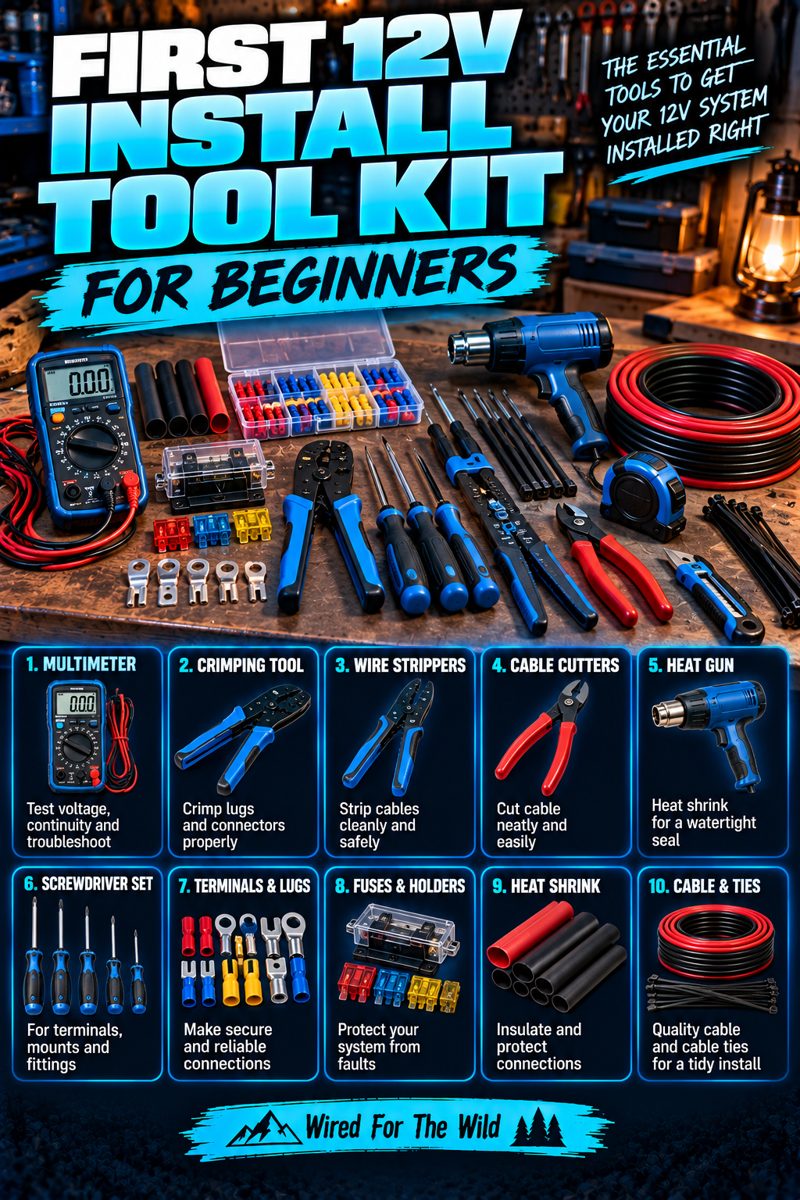
- Whatever type you use, check its voltage and current ratings, and mount it in a proper holder with a cover.
Common mistakes
- Sizing the fuse to the device instead of the cable.
- Mounting the fuse far from the battery, leaving a long unprotected cable.
- Forgetting the negative side when measuring the run length.
- Using the advertised auto cable size instead of the real copper area.
- Poor crimps, which cause heat and voltage drop even with the right cable.
When to get help
High-current gear such as inverters, DC-DC chargers and battery-to-battery links carries serious current. Follow the manufacturer's installation manual exactly, and if you're unsure, have an auto electrician check your work.
Gear picks
As an Amazon Associate I earn from qualifying purchases. Prices and availability are shown on Amazon.