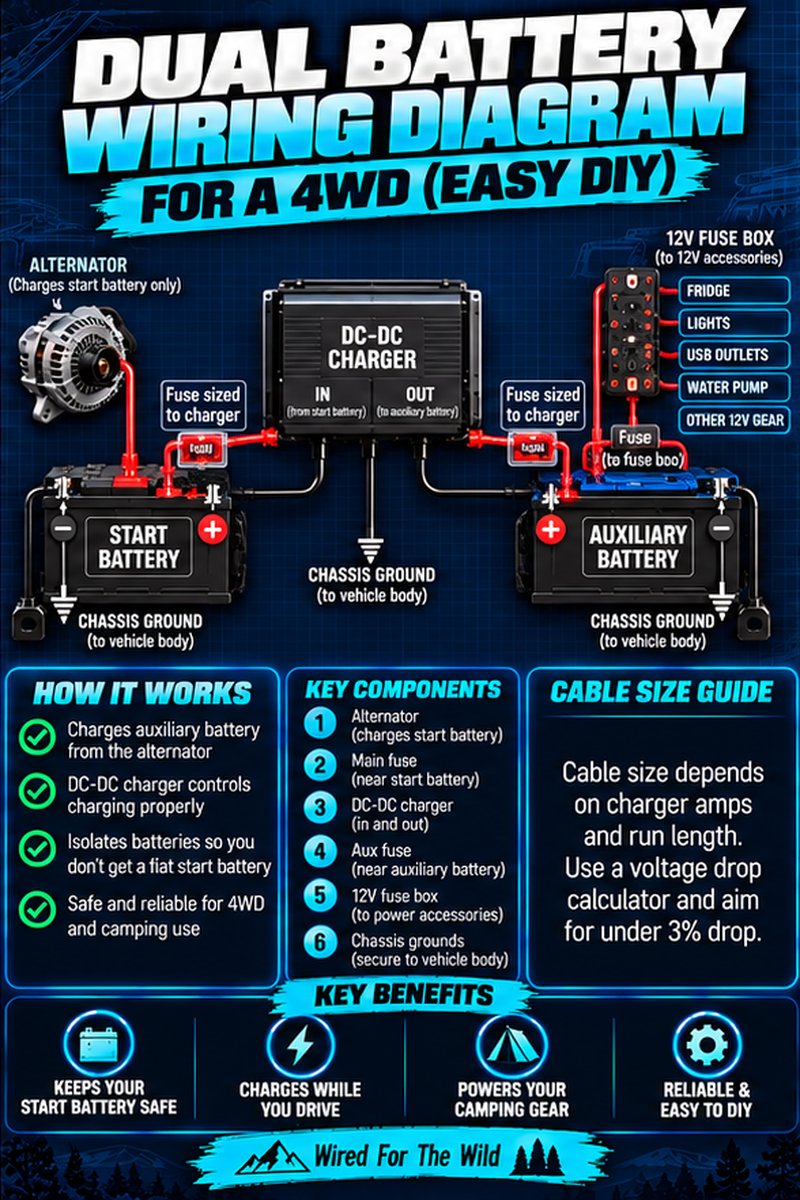
The quick answer
For most setups with a 100 to 200Ah auxiliary battery, a 25A DC-DC charger is the sweet spot. Go 20A for smaller batteries or simple setups, and 40A or more for big lithium banks or if you need to recharge fast on short drives.
Start with your battery size
- 20A: suits 50 to 100Ah batteries and simple setups.
- 25A: a great all-rounder for 100 to 200Ah.
- 40A and up: best for 200Ah and larger, or when you drive in short hops and need to put power back quickly.
Always check your battery's maximum recommended charge current. A charger bigger than the battery can accept won't help, and AGM batteries usually want a lower charge rate than lithium.
How long will it take to recharge?
As a rough guide, divide the amp hours you used by the charger's output. If you used 50Ah overnight, a 25A charger needs about 2 hours of driving to put it back, and a 40A charger about 1 hour 15 minutes. Real-world times are a bit longer because charging tapers as the battery gets close to full.
Other things that matter
- Smart alternators: many modern vehicles drop the alternator voltage to save fuel. Choose a charger that supports smart alternators and connect its ignition or trigger wire as the manual shows.
- Cable run: more current over a longer run needs thicker cable. A 40A charger feeding a caravan battery needs much heavier cable than a 20A charger under the bonnet.
- Where to mount it: putting the charger close to the auxiliary battery is often recommended, especially for caravans. Check the charger's temperature rating before mounting it in the engine bay.
- Solar input: many DC-DC chargers include an MPPT solar input, which can save buying a separate solar controller.
- Battery type setting: set the charger to match your battery (lithium, AGM or gel).
Caravans and camper trailers
Towing adds a long cable run from the car to the van through an Anderson plug. Voltage drop over that run is one of the most common reasons a van battery never fully charges. Many people mount the DC-DC charger in the van, close to the battery, and run heavy cable from the car's battery to the Anderson plug at the tow bar.
Quick FAQ
Can I use a bigger charger than I need? Yes, if your battery, cable and fuses are rated for its output.
Do I still need a solar controller? Not if your DC-DC charger has a solar input that suits your panels. Check its maximum panel voltage and current.
What about a VSR instead? A voltage sensitive relay is cheaper but doesn't work well with smart alternators or lithium. See our dual battery wiring guide.
Gear picks
Twin-core battery cable
- Sized for your charger and run length
- Auto-grade insulation
As an Amazon Associate I earn from qualifying purchases. Prices and availability are shown on Amazon.